A Will strengthened by medicine and law together.
Salus Legacy was formed from the cohesion of a medical and a legal background. That bridge lets us strengthen the evidential weight of the Wills we produce — without the hefty legal charges of a traditional law firm.
Two disciplines, one service
Salus Legacy was founded by two registered medical doctors and a legally trained director. The legal side gives our documents their structure — lawyer-developed templates and established Singapore drafting conventions. The medical side gives them something most Wills never receive: contemporaneous medical evidence of the will-maker’s mental capacity.
Because both capabilities sit under one roof, this combined protection comes at a fraction of the cost of engaging a law firm and a specialist doctor separately. You do not pay hefty legal charges for the bridge — it is built into the way we work.
Mental capacity: the question most disputes turn on
When a Will is challenged, the most common ground is that the will-maker lacked testamentary capacity — that they did not truly understand what they were signing. The challenge usually arrives years later, when the one person who could settle the question is no longer here to answer it.
Our registered medical practitioners can perform an additional mental capacity assessment at the time of signing and, with your consent, corroborate it against your records in the National Electronic Health Records (NEHR). A diagnosis or hospital admission sitting quietly in your medical history is exactly the kind of material a challenger may later raise to cast doubt on a Will’s validity. Reviewing it upfront allows our doctors to address it in a documented assessment — rather than leaving it to be discovered in court.
What real disputes look like
In June 2026, the Malaysian High Court began hearing a dispute over the RM1.6 billion estate of the late Lim Siew Kim, daughter of Genting founder Lim Goh Tong. The court was told that one of her wills was signed in a private hospital while she was undergoing treatment for ovarian cancer, a few months before she passed away. Her daughters challenge her mental capacity at the time of signing and allege suspicious circumstances; her lawyer maintains she was lucid. Whichever way the court eventually rules, the family faces years of litigation over a single question — the very question a documented medical assessment, made at the time of signing, is designed to answer.
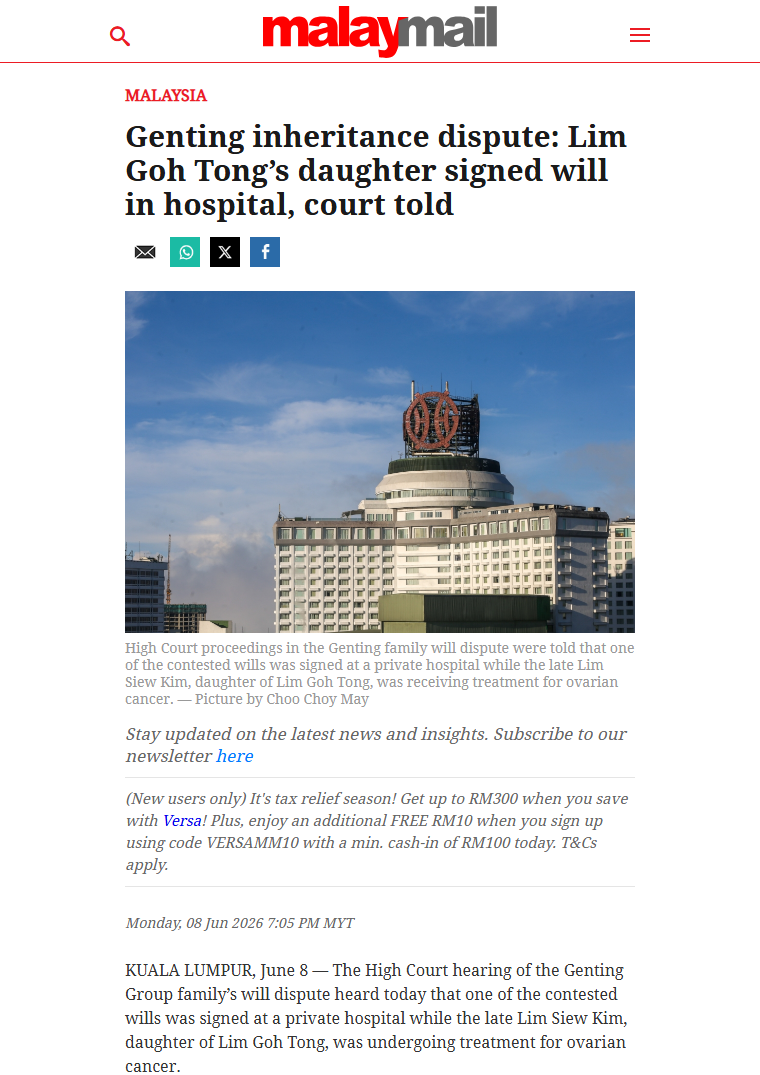

As published — click either clipping to read the original article. Images © Malay Mail, shown for reference.
Singapore’s courts have seen the same pattern. In Chee Mu Lin Muriel v Chee Ka Lin Caroline [2010] SGCA 27, the Court of Appeal upheld the setting aside of a will made by an elderly mother who was suffering from early dementia when she signed it. Cases like these are why English and Singapore practice has long encouraged the “golden rule”: when a will-maker is elderly or seriously ill, a medical practitioner should assess their capacity and record the findings at the time the will is made.
That is precisely the role our doctors play — and because Salus is medically led, this safeguard is built into our service rather than arranged as an afterthought.
A layer of protection — not a guarantee
We are careful not to overstate this. No Will — however it is prepared — can be made 100% incontestable. Any person with a sufficient interest may still bring a challenge, and a court will always weigh all the evidence before it.
What a contemporaneous, doctor-documented capacity assessment does is change the evidential landscape of any future dispute: instead of relatives and lawyers reconstructing a person’s state of mind years after the fact, there is a record made by a registered medical practitioner on the day, corroborated against national health records. That is a meaningful layer of protection — and one few will-writing services can offer.
Plan with both disciplines behind you
Most people finish in 12–20 minutes. Add a doctor-led capacity assessment when you book your signing.
Start the Will Writer →See Our ServicesInformation on this page, including references to court cases, is general information and not legal advice. Salus Legacy is a will-drafting service, not a law firm, and does not provide legal advice. A medical capacity assessment strengthens the evidence supporting a Will but cannot guarantee that it will never be challenged. For advice on your specific circumstances, please consult a practising solicitor.